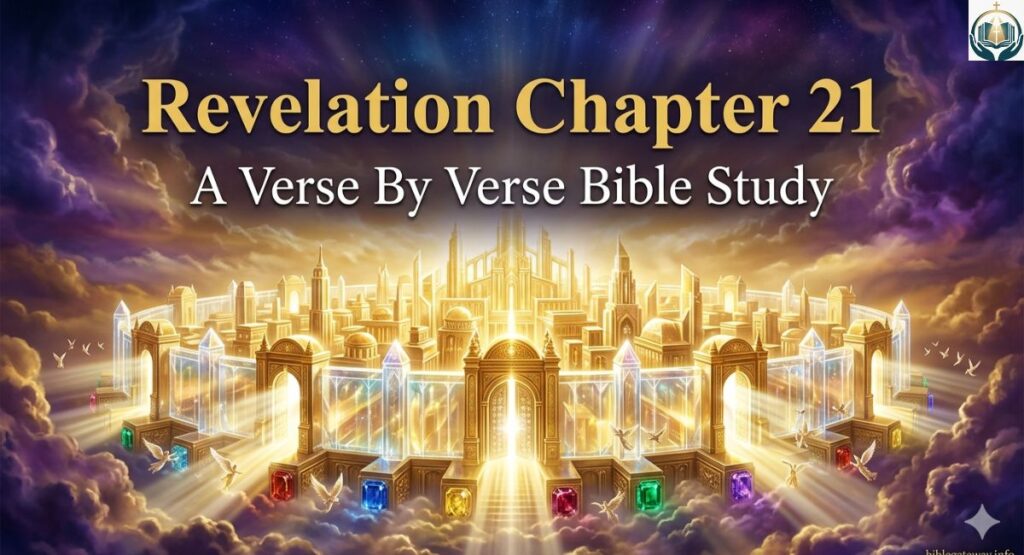
If you have ever wondered what eternity looks like, Revelation 21 gives you the closest glimpse Scripture offers. This powerful chapter pulls back the curtain on God’s ultimate plan — a new creation, a holy city, and the permanent end of suffering. Whether you are a seasoned Bible student or just beginning your journey through the Book of Revelation, this verse-by-verse study will walk you through every detail with clarity and depth.
Revelation Chapter 21
Revelation 21 stands as one of the most hope-filled passages in the entire Bible. After the dark drama of judgment throughout earlier chapters, this chapter bursts open with light, beauty, and divine restoration. God does not simply fix the broken world — He replaces it with something gloriously new.
Revelation 21:1 – Setting
“Then I saw a new heaven and a new earth, for the first heaven and the first earth had passed away, and the sea was no more.”
John opens with a dramatic scene shift. The old order — with all its corruption, death, and disorder — has been completely removed. Scholars debate whether this represents total re-creation or a thorough renewal of existing creation. The Greek word kainos (new) suggests a qualitative newness, not just novelty. Interestingly, the removal of the sea may symbolize the elimination of chaos, since in Jewish thought the sea often represented danger and separation.
Revelation 21:2 – First Glimpse of the New Jerusalem
“I saw the Holy City, the new Jerusalem, coming down out of heaven from God, prepared as a bride adorned for her husband.”
Here John witnesses the New Jerusalem descending from heaven — not built by human hands but prepared by God Himself. The bridal imagery is striking. Just as a bride dresses with great care for her wedding day, this city arrives in its fullest glory. This holy city represents the perfected community of God’s people, beautifully united with their Lord.
Revelation 21:3 – God Will Live With His People
“And I heard a loud voice from the throne saying, ‘Look! God’s dwelling place is now among the people, and he will dwell with them.'”
This verse captures the heartbeat of the entire Bible. From the Garden of Eden to the tabernacle, the temple, and finally the incarnation of Christ — God’s desire has always been to dwell with His people. In the new creation, that desire is fully and permanently realized. No more separation. No more barrier. Emmanuel — God with us — becomes the eternal reality.
Revelation 21:4 – Perfect Bliss
“He will wipe every tear from their eyes. There will be no more death or mourning or crying or pain, for the old order of things has passed away.”
Four enemies are officially defeated here: death, mourning, crying, and pain. Each of these was introduced through the fall in Genesis. Now God personally wipes away every tear. This is not a poetic exaggeration — it is a covenant promise. The tenderness of God reaching down to wipe a tear from a human face may be the most intimate image in all of Scripture.
Revelation 21:5 – New Creation from Jesus Christ
“He who was seated on the throne said, ‘I am making everything new!’ Then he said, ‘Write this down, for these words are trustworthy and true.'”
Jesus speaks directly here. His command to “write this down” underlines the reliability of what is being revealed. The phrase “making everything new” echoes Isaiah 43:19. This is not patching the old — it is a complete divine renovation. God’s authority over creation remains absolute, and His creative power has no end.
Revelation 21:6 – The New Creation Finished
“He said to me: ‘It is done. I am the Alpha and the Omega, the Beginning and the End. To the thirsty I will give water without cost from the spring of the water of life.'”
The declaration “It is done” mirrors Christ’s words on the cross — “It is finished.” What was begun at Calvary reaches its full completion here. The title Alpha and Omega — the first and last letters of the Greek alphabet — affirms that God encompasses all of history. The free gift of living water echoes Jesus’ conversation with the Samaritan woman in John 4.
Revelation 21:7 – Promises to the Overcomers
“Those who are victorious will inherit all this, and I will be their God and they will be my children.”
The word “overcomers” appears throughout Revelation’s letters to the seven churches. It does not refer to a spiritual elite — it describes every believer who perseveres in faith. The inheritance promised here is staggering: all things, plus the most personal relationship possible — to be called God’s own child.
Revelation 21:8 – The Second Death
“But the cowardly, the unbelieving, the vile, the murderers, the sexually immoral, those who practice magic arts, the idolaters and all liars — they will be consigned to the fiery lake of burning sulfur. This is the second death.”
Immediately after the promise of inheritance comes a solemn warning. The list here is not a ranking of the worst sinners but a portrait of unrepentant lifestyle patterns. The “second death” — the lake of fire — is the final and permanent separation from God. It is the ultimate consequence of choosing self over God throughout one’s earthly life.
Revelation 21:9 – The Anticipation
“One of the seven angels who had the seven bowls full of the seven last plagues came and said to me, ‘Come, I will show you the bride, the wife of the Lamb.'”
The same angel who had poured out God’s wrath now becomes a tour guide to eternal glory. This contrast is deliberate. God’s judgment and God’s grace flow from the same righteous throne. The bride — the New Jerusalem — is now ready to be fully revealed.
Revelation 21:10 – The Dwelling Place of the Bride
“And he carried me away in the Spirit to a mountain great and high, and showed me the Holy City, Jerusalem, coming down out of heaven from God.”
John is transported — in the Spirit — to a high vantage point. This mirrors the experience of Old Testament prophets like Ezekiel. The elevated view is intentional: to take in the full scope of what God has prepared. The city is coming down — heaven meeting earth in a permanent union.
Revelation 21:11 – The Lighted New Jerusalem
“It shone with the glory of God, and its brilliance was like that of a very precious jewel, like a jasper, clear as crystal.”
The city does not need a sun or lamp — it radiates with the glory of God Himself. The comparison to jasper (likely a brilliant, diamond-like stone in John’s time) conveys incomparable beauty and purity. This is a city lit from within by divine holiness.
Revelation 21:12 – New Jerusalem’s Boundaries
“It had a great, high wall with twelve gates, and with twelve angels at the gates.”
The wall signals security and definition. The twelve gates — named after the twelve tribes of Israel — show that God’s covenant with His Old Testament people is honored and fulfilled. Angels stand at each gate, not as guards to keep people out, but as heralds welcoming God’s redeemed.
Revelation 21:13 – Her Gates
“There were three gates on the east, three on the north, three on the south and three on the west.”
The four-directional layout — three gates on each side — indicates universal access from every part of the earth. No one redeemed is excluded by geography or ethnicity. God’s eternal city is open to all who belong to Him.
Revelation 21:14 – Her Foundations
“The wall of the city had twelve foundations, and on them were the names of the twelve apostles of the Lamb.”
The twelve apostles form the spiritual foundation of the New Jerusalem, consistent with Ephesians 2:20. Israel’s tribes and the church’s apostles together mark the full sweep of God’s redemptive work — both Testaments honored, both covenants fulfilled.
Revelation 21:15 – The Exact Measurements
“The angel who talked with me had a measuring rod of gold to measure the city, its gates and its walls.”
A golden measuring rod suggests the precision and perfection of what is being recorded. Measurements throughout Scripture often signify God’s ownership and care. Nothing about this city is accidental or approximate — every detail reflects divine intentionality.
Revelation 21:16 – Her Dimensions
“The city was laid out like a square, as long as it was wide. He measured the city with the rod and found it to be 12,000 stadia in length, and as wide and high as it is long.”
Twelve thousand stadia equals roughly 1,400 miles in each direction — length, width, and height. The perfect cube shape echoes the Holy of Holies in Solomon’s Temple (1 Kings 6:20), where God’s presence uniquely dwelled. The entire city is now a Most Holy Place.
Revelation 21:17 – The Wall
“The angel measured the wall using human measurement, and it was 144 cubits thick.”
The number 144 (12 × 12) carries the symbolic weight of completeness — twelve tribes times twelve apostles. The wall’s thickness speaks of absolute security. Nothing harmful can penetrate or threaten this eternal city.
Revelation 21:18 – Transparent Beauty
“The wall was made of jasper, and the city of pure gold, as pure as glass.”
Earthly gold is opaque. This heavenly gold is transparent — like glass. It is as if the city has nothing to hide. Every corner radiates divine purity. The jasper wall matches the earlier description of God’s glory, showing the entire city reflects His nature.
Revelation 21:19–20 – Foundations Described
The twelve foundations are adorned with twelve distinct precious stones:
| Foundation | Stone |
|---|---|
| 1st | Jasper |
| 2nd | Sapphire |
| 3rd | Chalcedony |
| 4th | Emerald |
| 5th | Sardonyx |
| 6th | Sardius |
| 7th | Chrysolite |
| 8th | Beryl |
| 9th | Topaz |
| 10th | Chrysoprase |
| 11th | Jacinth |
| 12th | Amethyst |
These stones mirror the gems on the high priest’s breastplate in Exodus 28, connecting the priestly role of Israel to the glorified community of believers. The beauty is not about material wealth — it communicates holiness, permanence, and the diversity of God’s people.
Revelation 21:21 – Pearly Gates
“The twelve gates were twelve pearls, each gate made of a single pearl. The great street of the city was of pure gold, like transparent glass.”
Each gate carved from a single enormous pearl has captured the Christian imagination for centuries. Pearls are formed through suffering — an oyster’s response to an irritant. Some commentators suggest this symbolizes how entrance into God’s kingdom was purchased through Christ’s suffering. The gold streets reinforce heaven’s character: what the world treasures most becomes pavement in God’s city.
Revelation 21:22 – No Temple
“I did not see a temple in the city, because the Lord God Almighty and the Lamb are its temple.”
This is breathtaking. Temples exist because of distance between God and humanity. In the new creation, that distance no longer exists. God Himself — Father and Son — is the temple. Every believer lives in direct, unmediated communion with their Creator. No ritual, no building, no priest stands between God and His people.
Revelation 21:23 – Spiritual Light
“The city does not need the sun or the moon to shine on it, for the glory of God gives it light, and the Lamb is its lamp.”
The sun and moon — created on the fourth day — served their purpose in the old creation. In the new creation, God’s own glory surpasses any natural light source. The Lamb (Jesus Christ) serves as the personal lamp of the city, fulfilling Isaiah 60:19: “The LORD will be your everlasting light.”
Revelation 21:24 – Its Population
“The nations will walk by its light, and the kings of the earth will bring their splendor into it.”
The redeemed come from every nation, tribe, and language — echoing Revelation 7:9. Even the concept of “kings” shows that legitimate human dignity and cultural achievement are not erased but redeemed and brought into God’s eternal city as an offering of honor.
Revelation 21:25 – No Night
“On no day will its gates ever be shut, for there will be no night there.”
Ancient cities shut their gates at night for protection against enemies. In the New Jerusalem, gates never close because no enemy exists. The absence of night is not merely astronomical — it is spiritual. Darkness, fear, and evil have been permanently banished.
Revelation 21:26 – Glory and Honor
“The glory and honor of the nations will be brought into it.”
Everything good, true, and beautiful from human history — every genuine achievement of art, music, science, and culture made by redeemed humanity — finds its place in God’s eternal city. Nothing truly good is lost. It is gathered and offered to God’s glory.
Revelation 21:27 – Purity
“Nothing impure will ever enter it, nor will anyone who does what is shameful or deceitful, but only those whose names are written in the Lamb’s book of life.”
The chapter closes with a firm boundary. The New Jerusalem is not a city of mixed company. Its purity is absolute. The only qualification for entry is having one’s name written in the Lamb’s Book of Life — secured not by personal merit but by faith in Jesus Christ.
Revelation Chapter 21 – Study/Review Questions
Use these questions for personal reflection or group discussion:
- What does the removal of the sea in verse 1 symbolize to you personally?
- How does the bridal imagery of the New Jerusalem shape your understanding of the Church?
- What does it mean that God will personally wipe every tear from your eyes?
- Why do you think both the twelve tribes of Israel and the twelve apostles are named in the city’s structure?
- What does the absence of a temple teach us about our future relationship with God?
- How does the image of transparent gold challenge your assumptions about what heaven will be like?
- What does the open gates (never shut) reveal about the character of the New Jerusalem?
- Why is the Lamb’s Book of Life the only credential that grants entrance?
Revelation Chapter 21 – Personal Reflection Question
If God promised today to wipe every tear from your eyes — every loss, every heartbreak, every unanswered prayer — what specific tears are you trusting Him to dry in eternity?
Take a moment to sit with that. Revelation 21 was written not just as prophecy, but as comfort for believers who are suffering right now.
Revelation Chapter 21 – Behind the Scenes Stuff
A few important background details that enrich your reading:
- Author and Date: The Book of Revelation was written by John the Apostle around AD 95, likely during the reign of Emperor Domitian, when Christians faced intense persecution.
- Literary Genre: Revelation is apocalyptic literature — a style that uses symbolic imagery, numbers, and visions to communicate spiritual realities.
- The Number 12: It appears throughout this chapter (12 gates, 12 tribes, 12 apostles, 12 foundations, 12,000 stadia, 144 cubits). In biblical numerology, 12 represents divine governance and completeness.
- Old Testament Echoes: Revelation 21 draws heavily from Isaiah 60, Ezekiel 40–48, and Isaiah 65. John is not inventing new theology — he is showing how all of Scripture’s promises converge.
- The Cube Shape: The only other perfect cube in the Bible is the Holy of Holies (1 Kings 6:20), the most sacred space in the Temple where God’s presence dwelled. The entire New Jerusalem takes that shape — God’s glory fills every corner.
Frequently Asked Questions
What is Revelation Chapter 21 about?
Revelation 21 describes the new creation following God’s final judgment — featuring a new heaven, a new earth, and the descent of the New Jerusalem as God permanently dwells with His redeemed people.
What is the New Jerusalem in Revelation 21?
The New Jerusalem is the holy city that descends from heaven, representing the perfected community of God’s people — both spiritually (the Bride of Christ) and physically (a literal, glorious city).
What does “no more tears” mean in Revelation 21?
It means God Himself will personally and permanently remove all pain, grief, death, and suffering from the experience of His people for eternity — a complete reversal of the consequences of sin.
What does the new heaven and new earth represent?
They represent God’s complete renovation of all creation — restoring it to a state of perfect holiness, beauty, and order, free from the corruption introduced by sin in Genesis 3.
What does Revelation 21 teach about God’s presence?
It teaches that God’s ultimate goal has always been direct, unhindered communion with His people — and in the new creation, that goal is permanently achieved without temples, rituals, or barriers.
Why is the New Jerusalem described with precious stones?
The precious stones mirror the high priest’s breastplate in Exodus 28, symbolizing holiness, divine beauty, and the priestly status of all God’s redeemed people — not material wealth, but spiritual glory.
What is the meaning of “Alpha and Omega” in Revelation 21?
Alpha and Omega are the first and last letters of the Greek alphabet, declaring that God is the source, sustainer, and final destination of all history — nothing exists outside His sovereign reach.
Who will inherit the promises in Revelation 21?
The overcomers — all who persevere in faith in Jesus Christ — will inherit the new creation and enjoy the full relationship of being God’s children for eternity.
What warning does Revelation 21 give?
Verse 8 warns that those who persist in unbelief and unrepentant sin will face the second death — the lake of fire — which is permanent separation from God.
Why is Revelation 21 important for believers?
It anchors hope. When suffering feels overwhelming, this chapter reminds believers that their present pain is temporary — and what God is preparing for them is beyond imagination.
Conclusion
Revelation 21 is not a fairy tale — it is the final chapter of history written by the God who keeps every promise. From the descent of the New Jerusalem to the wiping away of every tear, this chapter invites believers to lift their eyes above present suffering and fix their gaze on what is coming.
The New Jerusalem is not a reward for the perfect — it is a home prepared for the forgiven. If your name is written in the Lamb’s Book of Life, this is your future. Let that reality reshape how you face today.
Study Revelation 21 not merely as prophecy to analyze, but as a promise to live by.