
Who was the first person cremated in the Bible? It is one of those questions that sounds simple but opens up a fascinating and layered study of Scripture. The word “cremation” never appears in the King James Bible, yet fire and burning appear throughout — connected to divine judgment, wartime necessity, and pagan rituals. To find the first cremation, we need to look carefully at what actually happened and why.
Most people are surprised to discover that ancient Israelites strongly preferred burial over burning. When fire did consume human bodies in Scripture, it usually carried a message — about sin, punishment, or desperate circumstances. Understanding those stories gives us a clearer picture of what God values when it comes to how we treat the dead.
Who Was The First Person Cremated In The Bible? – Old Testament
The Old Testament establishes burial as the standard practice among God’s people. From Abraham burying Sarah (Genesis 23) to Jacob being laid in the cave of Machpelah, burial was the consistent, honored tradition. It reflected both respect for the body as God’s creation and a theological hope in the resurrection of the dead.
Burning a body, by contrast, was rare — and when it did occur, it almost always carried a heavy spiritual meaning. The Old Testament shows us at least three distinct types of burning: divine judgment, criminal punishment, and emergency wartime measures. None of these is cremation in the modern sense, but they form the biblical foundation for understanding the topic.
Who Was The First Person Cremated In The Bible? – Two Cities
According to the biblical study principle known as the Law of First Mention, the first time a concept appears in Scripture reveals God’s perspective on it. By that standard, the first burning of human bodies in the Bible occurs not with an individual, but with two entire cities.
Genesis 19:24 – God Sent Fire to Destroy
“Then the LORD rained down burning sulfur on Sodom and Gomorrah — from the LORD out of the heavens.”
God sent fire and brimstone from heaven upon Sodom and Gomorrah as an act of divine judgment on their wickedness. Every person in those cities was consumed. This was not a funeral practice — it was a display of God’s wrath against unrepentant sin.
Genesis 19:28 – The Effects of the Heavenly Fire
“He looked down toward Sodom and Gomorrah, toward all the land of the plain, and he saw dense smoke rising from the land, like smoke from a furnace.”
The imagery is sobering. Fire in this context is a symbol of divine judgment — a warning that runs throughout the rest of Scripture. This earliest burning sets the tone: fire consuming human bodies is connected, first and foremost, to the consequences of sin.
Who Was the First Person Cremated in the Bible? — Achan — The “Troubler of Israel”
If Sodom and Gomorrah represent mass divine judgment, then Achan gives us the first recorded burning of an individual in the Bible — and it was equally connected to sin.
Achan, from the tribe of Judah, secretly took forbidden items from the destroyed city of Jericho, directly disobeying God’s command. His hidden sin caused Israel to suffer defeat at the battle of Ai. When his guilt was discovered, the consequences were severe.
Joshua 7:25 (KJV):
“And Joshua said, Why hast thou troubled us? the LORD shall trouble thee this day. And all Israel stoned him with stones, and burned them with fire, after they had stoned them with stones.”
| Detail | Description |
|---|---|
| Who | Achan and his family |
| Sin | Taking devoted items from Jericho (Joshua 7:1) |
| Punishment | Stoning, followed by burning |
| Significance | First recorded burning of an individual in the Bible |
| Title | “The Troubler of Israel” (1 Chronicles 2:7) |
Achan’s burning was not a burial choice — it was judicial punishment following execution. It served as a public declaration of the seriousness of covenant betrayal. Many Bible scholars identify Achan as the first individual person burned in the Bible.
Who Was The First Person Cremated In The Bible? – The Body Of King Saul
The most commonly cited candidate for the first cremation in the Bible is King Saul. His account in 1 Samuel 31 is unique because the burning was done out of respect, not judgment.
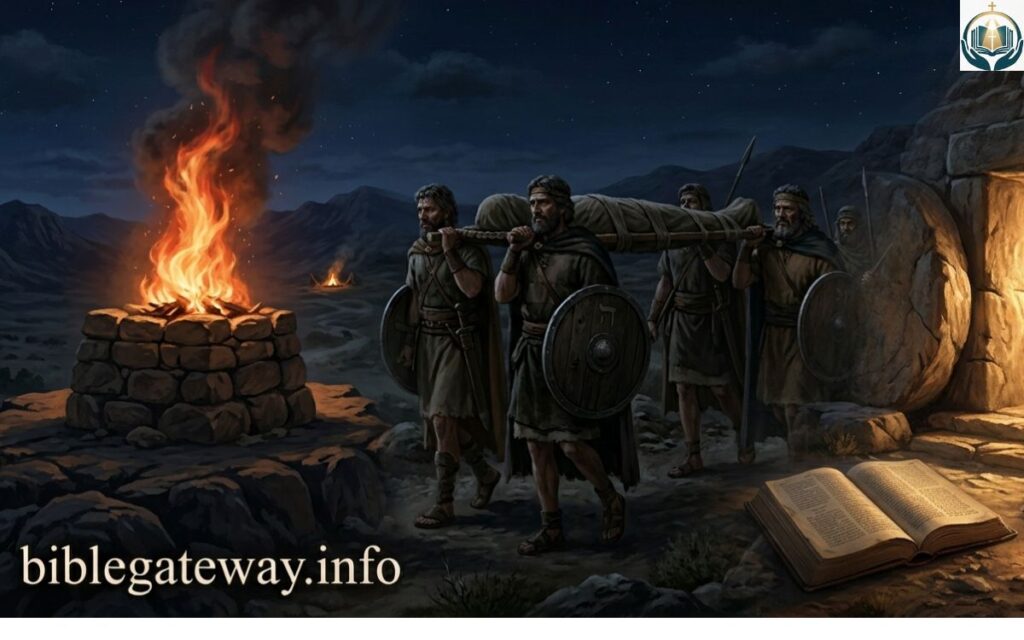
After Saul and his three sons died in battle against the Philistines on Mount Gilboa, the Philistines publicly desecrated their bodies — fastening them to the wall of Beth-shan. When the men of Jabesh-Gilead heard this, they traveled through the night, retrieved the bodies, and then took a remarkable action:
1 Samuel 31:12–13:
“All the valiant men arose and traveled all night, and took the body of Saul and the bodies of his sons from the wall of Beth-shan, and came to Jabesh, and burned them there. And they took their bones and buried them under a tamarisk tree at Jabesh, and fasted seven days.”
This account stands apart from Achan’s burning in one crucial way — it was an act of honor and loyalty, not punishment. The men of Jabesh-Gilead burned the mutilated bodies to prevent further desecration, then carefully buried the remaining bones with fasting and mourning.
Many scholars and pastors, including John MacArthur, note that this was an emergency measure, not a standard practice. But it remains the closest thing to a compassionate cremation found in the Old Testament.
Who Was The First Person Cremated In The Bible? – Burnings
Beyond Achan and Saul, the Old Testament records several burning-related events at royal funerals. These were not full cremations but ceremonial burnings held in honor of deceased kings.
2 Chronicles 16:14 – Good King Asa
“They buried him in the tomb that he had cut out for himself in the City of David. They laid him on a bier covered with spices and various blended perfumes, and they made a huge fire in his honor.”
A large fire was lit as a sign of royal respect — not to burn the body, but to honor the king’s passing.
2 Chronicles 21:19 – Evil King Jehoram
“His people made no funeral fire in his honor, as they had for his predecessors.”
This verse reveals that the absence of a burning fire at a royal funeral was seen as a mark of dishonor. The contrast shows how significant these ceremonial fires were in ancient Israelite culture.
Burnings in Ancient Israel – A Sign of Honor
| King | Burning? | Meaning |
|---|---|---|
| King Asa (2 Chr 16:14) | Yes — large fire | Honor and respect |
| King Jehoram (2 Chr 21:19) | No fire made | Dishonor and disgrace |
| King Saul (1 Sam 31:12) | Body burned | Emergency, then buried |
These ceremonial burnings were distinct from cremation. The body was still buried; the fire was a public tribute.
Who Was The First Person Cremated In The Bible? – Idolatry And Human Sacrifice
One of the darkest forms of burning in the Old Testament involves child sacrifice — a pagan practice that God explicitly condemned. These passages show burning in its most grievous context.
Leviticus 18:21 – God Commanded Against Child Sacrifice
“Do not give any of your children to be sacrificed to Molek, for you must not profane the name of your God.”
Deuteronomy 18:10 – God Repeated His Warning Against Child Sacrifice
“Let no one be found among you who sacrifices their son or daughter in the fire.”
2 Chronicles 28:3 – King Ahaz Sacrificed His Children As An Offering To A False God
King Ahaz walked in the ways of the pagan nations, burning his own sons in the Valley of Ben Hinnom as offerings to false gods — a direct violation of God’s law.
2 Kings 21:6 – King Manasseh Sacrificed His Son To A False God
Manasseh, one of Judah’s most wicked kings, also burned his son as an offering, practicing sorcery and consulting mediums.
Jeremiah 19:5 – The Prophet Jeremiah Mourned Over Idolatrous Evil Practices.
“They have built the high places of Baal to burn their children in the fire as offerings to Baal — something I did not command or mention, nor did it enter my mind.”
Jeremiah 32:35 – The Prophet Jeremiah Wept Over The Practice Of Child Sacrifice.
God made clear through Jeremiah that this practice was utterly foreign to His character and deeply grieved Him. The burning of children in idol worship represents the sharpest possible contrast to the God who values every human life as His own creation.
Who Was The First Person Cremated In The Bible? – New Testament
In the New Testament, the practice of burial remains firmly established as the norm for God’s people. Every major death recorded follows the pattern of burial, not burning.
Matthew 14:12 – John The Baptist Was Buried
“John’s disciples came and took his body and buried it.”
Even after being beheaded, John the Baptist’s disciples ensured he received a proper burial — honoring his body with dignity.
Acts 5:9–10 – Ananias And Sapphira Were Buried.
Both Ananias and Sapphira fell dead after lying to the Holy Spirit. In both cases, the young men present “came forward, wrapped up her body, and carried her out and buried her” — immediate and respectful burial, even for those who had sinned.
Acts 8:2 – Stephen – The First Martyr Was Buried
“Godly men buried Stephen and mourned deeply for him.”
Stephen, the first Christian martyr, was given a proper burial after being stoned to death. The New Testament pattern is consistent: burial reflects dignity, respect, and resurrection hope.
Who Was The First Person Cremated In The Bible? – Burial or Cremation for the Christian Today?
The Bible never directly forbids cremation, but it consistently presents burial as the preferred practice of God’s people — rooted in theology, not tradition alone.
Key reasons early believers chose burial:
- The body is described as a temple of the Holy Spirit (1 Corinthians 6:19–20)
- Burial expresses hope in the resurrection of the body
- God’s image is stamped on every person, making the body worthy of dignity
- Jesus Himself was buried — and His empty tomb became the foundation of the Christian faith
That said, many theologians and pastors today agree that cremation is not a sin. God’s power to resurrect is not limited by the condition of the body. Whether a body is buried, cremated, or lost at sea, God can and will raise it on the last day.
The most important factor is motive and reverence — treating the body with honor and making decisions rooted in faith rather than disrespect.
Who Was The First Person Cremated In The Bible? – Jesus Christ — Our Perfect Example
Jesus’ burial is not a minor detail — it is central to the gospel itself.
1 Corinthians 15:3–4:
“For I delivered to you as of first importance what I also received: that Christ died for our sins in accordance with the Scriptures, that He was buried, and that He was raised on the third day.”
Jesus was wrapped in linen cloths, placed in a sealed tomb, and rose bodily three days later. His burial validated His death. His empty tomb proclaimed His resurrection. Following His example, the early church embraced burial as a powerful confession of faith — a declaration that death is not the end, and that the same God who raised Jesus will raise all who belong to Him.
Frequently Asked Questions
Who was the first person cremated in the Bible?
Most scholars point to Achan (Joshua 7:25) as the first individual whose body was burned as a punishment for sin. King Saul (1 Samuel 31:12) is also cited as the first example of a compassionate burning done out of respect.
Did the Bible mention cremation at all?
The word “cremation” never appears in Scripture, but there are three to four instances where bodies were burned — connected to judgment, emergency wartime situations, or pagan worship, not standard burial customs.
Was anyone in the Old Testament burned after death?
Yes — Achan was stoned and burned as punishment (Joshua 7:25), and King Saul’s mutilated body was burned by the men of Jabesh-Gilead to preserve his dignity (1 Samuel 31:12).
Why didn’t biblical figures get cremated?
Ancient Israelites believed the body bore God’s image and was sacred. Burial also reflected theological hope in the bodily resurrection — a core belief that made burning the body spiritually uncomfortable.
Is cremation a sin according to the Bible?
No direct Bible verse calls cremation a sin. Most modern Christian theologians agree that it is a matter of personal or cultural choice, as God’s resurrection power is not limited by how a body was handled after death.
Were any pagan sacrifices burned in the Bible?
Yes — child sacrifice by fire was practiced by wicked kings like Ahaz (2 Chronicles 28:3) and Manasseh (2 Kings 21:6), and strongly condemned by God through prophets like Jeremiah (Jeremiah 19:5).
Did Jesus get cremated?
No. Jesus was wrapped in linen and placed in a tomb (John 19:40–42). His burial and bodily resurrection are foundational to the Christian gospel (1 Corinthians 15:3–4).
How about John the Baptist? Was he cremated?
No. Matthew 14:12 records that John’s disciples “came and took his body and buried it” — a proper burial following the traditional Jewish custom.
Does cremation appear in any Bible story?
The closest examples are Achan’s burning after stoning (Joshua 7:25) and King Saul’s body being burned by loyal followers (1 Samuel 31:12). Neither matches modern cremation as a chosen funeral practice.
Can Christians choose cremation today?
Yes, most Christian denominations permit cremation today. The Bible does not forbid it, and God’s power to resurrect is not dependent on the physical state of the body (1 Corinthians 15:42–44).
Conclusion
So who was the first person cremated in the Bible? The honest answer is: it depends on how you define cremation. If it means any burning of human remains, the people of Sodom and Gomorrah come first, consumed by divine fire in judgment. If it means the first individual burned, that is Achan, whose body was burned as punishment after stoning. If it means the first burning done with respect and compassion, that honor belongs to King Saul, whose loyal supporters chose to burn his mutilated body rather than leave it to further disgrace.
What unites all these accounts is a consistent biblical truth: God cares about the human body. He made it, He stamps His image on it, and He promises to raise it. Whether you choose burial or cremation today, the most important thing is that decisions are made with reverence, faith, and a firm belief in the resurrection that awaits every believer.
“So will it be with the resurrection of the dead. The body that is sown is perishable; it is raised imperishable.” — 1 Corinthians 15:42